Results for 'papa'
pāpā - father, uncle
papa - floor, ground, flat surface
papā - burst, explode
Pāpā. ‖ pā (i), (iii), (v), (vi).
Williams Dictionary
Papā. ‖ pā (iv).
Williams Dictionary
Papa (i). 1. n. Anything broad, flat, and hard; flat rock, slab, board. Oti ake nga papa e rua, ko nga ingoa o nga papa nei na ko Tahitahia, ko Rakerakea (T. 35). Especially the broad board for closing the doorway or window of a Maori house, so door, shutter. Ka toia te papa o tona whare kia tuwhera (T. 172). Papa reti, board used as a toboggan; the term is also applied to some form of epidemic sickness. He auau no te mate, i poua, e tai, ki te papa-reti (S.). Papa takiri, a piece of wood about 6 in. by ½ in., sometimes used in starting a humming top. Papaara, some part of a canoe.
2. Earth floor or site of a native house. Ko te papa o te whare wananga e tahia i te tuatahi (W.W. 2). Hence the modern expression papa kāinga.
3. Bed of a lake. Te manu kei taua roto he manapou, e rua tikitiki o te upoko; ko ana tamariki he mea ruku ki te papa o te moana whanau ai.
4. A name for the Earth, generally used in relation to Rangi. Katahi ka mawehe a Rangi raua ko Papa (T. 4). Fuller forms of the name are Papa-tu-a-nuku and Papa-tahua-roa. Kotahi ano te tupuna o te tangata maori, ko Rangi-nui e tu nei, ko Papatu-a-nuku e takoto nei (T. 3).
5. Used with a plant name to indicate ground covered with certain vegetation, as papa taraire, papa korari, etc.
6. Quarrel, ground of dispute. He papa taku ki a ia (I have offended him). Ka riro i a au te papa (I have gained the victory). Tuawha ki tona, tuawha ki toku, i a au te papa (T. 200). Papa kore, without grounds, needlessly. I mate papa kore te uri o Kaitoa (P. 66).
7. The flax foundation of a dogskin or feather cape.
8. Width, strip, in weaving a floor mat, the joining seams being termed hiki or maurua. I te maurua kotahi e rua papa, i te rua maurua e toru papa.
9. Mesh of a net.
10. Shell of crayfish, molluscs, etc. Kua tupu te papa o te koura. Papa tio, oyster shell; papa pipi, cockle shell, etc. Papa o te angaanga or papa angaanga, skull. Papaahu, skull; also some part of a rua kumara. Tana papa-ahu ko Papatahia (S. ii, 83). Papa-āhuahua, shoulder-blade.
11. a. Lying flat, thrown down. Ka tukua iho e Maui te huka kapo; ka uruhia papakia te huka (Tr. vii, 38). Whiri papa, flat platted cord of three strands.
papanga, n. 1. Site. Kotahi papanga kainga.
2. Layer, course. E rua pea papanga o te kareao, e toru ranei, ka oti (T. 154). Papanga rua or papa rua, twofold, of fabric.
3. Cause of discord. In the passage, Kia tika ki te uru, mo te tai awatea, mo Te Huakiwi; he papanga kei raro, kia rere maramara ki roto Taupo (M. 239). (Grey interprets as “dead bodies heaped upon one another, i.e., of two parties chief after chief is alternately killed for revenge; any one of them is said to be slain upon a papanga.” But it seems more probable that the word here has the meaning given above.)
whakapapa. 1. v.i. Lie flat. Whakapapa tonu te manuhiri i te mate (T. 172).
2. Go slyly or stealthily. Ka whakapapa mai te tangata ra; he tahae pea.
3. v.t. Lay low, strike down.
4. Place in layers, lay one upon another.
5. Recite in proper order genealogies, legends, etc. I haere mai ia ki te whakapapa i nga kauwhau o mua.
6. n. Genealogical table.
7. Bush felled for burning; as opposed to hapai tu, timber felled and carried off the ground.
whakapaparanga, n. 1. Layer, series of layers.
2. Generation.
pāpapa, n. 1. Shell, of an egg, crayfish, etc.
Williams Dictionary
Papa (ii), n. 1. Box, chest. Papa huia, papa hou, a carved box for holding huia feathers. Papa tupapaku, bone chest, in which bones were placed after having been scraped.
2. A vessel made of totara bark for holding preserved birds, etc. Ka mea atu te tangata nei ki tana hoa kia hoatu a raua kai ki nga wahine nei, he huahua kuku, e rua papa hinu (T. 138). Sometimes called papapātua. Pau ake nga taha, tango atu ki nga papapatua (T. 94). ‖ patua.
3. Medium of communication with an atua. Also called papa atua. The term
page 260
tohunga papa kikokiko appears to be connected with this, and probably = matakite, seer. ‖ kaupapa.
4. Some object, animate or inanimate, indicated by occult means, which must be seen, killed, or captured, as the case may be, in order to ensure the success of a war party. He waka papa a Te Hiahia.—Ko te tangata i kitea i te moemoea, ara te tangata papa, ko Matangaua. ‖ Wai. 48, 49.
‖ waka.
Williams Dictionary
Papa (iii), n. Breech, buttock. Ka whiti te tao te papa o te iramutu, taua rua nga papa; oi tonu (Pi. 175, 2). Kei nga papa te mamae.
Williams Dictionary
pāpā, v.t. Ram, or compress with the hand.
He mea papa te oneone.—Kua papatia te oneone.
Williams Dictionary
pāpā, v.i. Be overcome. Papa noa; kihai i rere, kihai i aha (T. 7). Ko ona tuakana i papa noa i te ngaunga a Tawhiri ratou ko ana tama (T. 6).
Williams Dictionary
papa, v.i. 1. Burst, explode. Ka papa te whatitiri (M. 413).
2. Break off suddenly or shortly. He mea papa noa te rakau.
3. Chatter as teeth with cold; chirp. He tarakihi e papa ana i te waru.
Williams Dictionary
pāpā, n. 1. Father, brother of father or mother. Katahi te tangata ra ka kawea ki te wai e tona papa, ka tohia (T. 17). No te reo rawa o tona iramutu, tama a tona tuahine, i karanga ake ki tona papa (J. ii, 222). Papa whakaangi, stepfather. Papa kēkē, male relatives in the same generation as father or mother.
2. Elders, male relatives. Ka ui korero atu nga papa, “He aha koe i kitea mai ai?”(T.89).
Williams Dictionary
papa. 1. n. Geniostoma ligustrifolium, a shrub. = papahenga.
2. Hoplodactylus pacificus, brown gecko, a lizard. = moko-papa, ngarara-papa, teretere.
3. A variety of inanga, a fish.
4. a. Spreading. He rakau papa. ‖ kura-pāpā.
Williams Dictionary
Ko Brian tōku pāpā.
Brian is my father.
Identity sentences - ko...
Ko wai te ingoa o tō pāpā?
What is the name of your mother?
Asking who - Ko wai...?
Ko wai te pāpā o Tama?
Whose Tama's dad?
Asking who - Ko wai...?
Ko wai tō pāpā?
Who is your Dad?
Asking who - Ko wai...?
Ko wai te pāpā?
Who is the father?
Asking who - Ko wai...?
Ko wai i tākaro i te papa tākaro?
Who played at the playground?
Asking who - Ko wai...?
Ehara tōku pāpā i te rangatira.
My father is not a leader.
Negations of identity sentences - ehara...
Ehara tēnei i te papa tākaro.
This is not a playground.
Negations of identity sentences - ehara...
Kei te haere au ki te papa hokohoko.
I'm going to the mall.
Simple sentences: present tense with a verb - kei te
Kei te tahitahi a Hera i te papa.
Hera is sweeping the floor.
Simple sentences: present tense with a verb - kei te
Kei te whakapakari tinana rātou ki te papa tākaro.
They are exercising at the playground.
Simple sentences: present tense with a verb - kei te
Kei te tākaro a Pita i te papa tākaro.
Pita is playing at the playground.
Simple sentences: present tense with a verb - kei te
E tākaro ana rāua i te papa tākaro.
They (two people) are playing at the playground.
Simple sentences: present tense - e... ana
Ka kite kōrua i a Pāpā Poaka ā tērā tau.
You two will see Pāpā Poaka next year.
Simple sentences: future tense - ka
Kua oti i taku pāpā te kai te tunu.
My father has finished cooking.
Simple sentences: past completed tense - kua
Kua oma ngā tamariki i te papa tākaro.
The children have run in the playground.
Simple sentences: past completed tense - kua
Kua ruaki koe ki runga i a Pāpā.
You just threw up on Daddy.
Simple sentences: past completed tense - kua
Me purumu au i te papa.
I'd better sweep the floor.
Simple sentences: you should - me
Me tunu a pāpā i te kai.
Dad should cook the food.
Simple sentences: you should - me
Me horopuehu a Mere i te papa.
Mere should vauum the floor.
Simple sentences: you should - me
Kei Rangitīkei tāku pāpā e mahi ana.
My father is working in Rangitīkei.
Kei hea tō pāpā e mahi ana?
Where is your father working?
Pēnei a Pāpā e tunu ana koe i te tina.
Dad thought you were cooking dinner.
I thought mistakenly - Pēnei au...
Ki a Pāpā te whāngai i te ngeru.
Dad will feed the cat.
Who is going to... - Ki a wai te...?
He rite tonu ia ki tōna pāpā.
He is just like his father.
This is just like that - he rite tonu
He rite tonu a Mere ki tōna pāpā.
Mere is just like her dad.
This is just like that - he rite tonu
He rite tonu tāku teina ki tōku pāpā.
My younger sibling is just like my father.
This is just like that - he rite tonu
He rite tāku irāmutu ki tōna pāpā.
My nephew is just like his like father.
This is just like that - he rite tonu
He rite tonu ia ki tōna pāpā mō te mahi whenua.
He is just like his father when it comes to farming.
This is just like that - he rite tonu
He rite a Hone ki tōna pāpā.
Hone is just like his father.
This is just like that - he rite tonu
He rite tonu tēnei kuri ki tōna pāpa.
This dog is just like its father.
This is just like that - he rite tonu
He rite tonu te āhua o Tawa ki tōna pāpā.
Tawa looks just like his father.
This is just like that - he rite tonu
He rite tonu au ki tōku pāpā.
I am just like my father.
This is just like that - he rite tonu
He aha te mahi a Pāpā i te Rātapu?
What does Dad do on Sunday?
What are you doing? - He aha tāu mahi?
Kia ahatia. He rākau noa iho te papa, he māmā te horoi.
Never mind. It's a wooden floor. It's easy to clean.
Never mind the... No worries! - Hei aha te..., Kia ahatia!
Kia ahatia, he māmā noa iho muku i te papa.
Never mind, the floor's easy to wipe.
Never mind the... No worries! - Hei aha te..., Kia ahatia!
Taihoa koe e haere ki te wharepaku kātahi anō a Pāpā ka puta i reira.
Don't you go to the toilet, Pāpā has just come out.
Don't... just yet! - Taihoa... e
Taihoa e pōtarotaro pātītī kei te mākū tonu te papa.
Don't mow the lawns the grass is still wet.
Don't... just yet! - Taihoa... e
E rata ana a Pāpā ki te mātakitaki pouaka whakaata.
Pāpā likes to watch television.
To like - rata
Kāore au e rata ki te tahitahi papa, he hōhā.
I don't like sweeping the floor, it's annoying.
To like - rata
Nō muri tata mai ka whakamōtoro a Tangaroa i a Papa.
Shortly afterwards Papa was seduced by Tangaroa.
Belonging to the past - nō
Nō muri i te piringa o Rangi rāua ko Papa ka whānau mai ngā tamariki.
After the union of Rangi and Papa, the children were born.
Belonging to the past - nō
Nō te wā o te piringa o Rangi rāua ko Papa ka tupu te werawera, ka rērere te kohu.
At the time of the union of Rangi and Papa, the heat grew, the mist rose.
Belonging to the past - nō
Nō mua i te piringa ki a Rangi, ka moe a Papa rāua ko Tangaroa.
Before the union with Rangi, Papa was in a relationship with Tangaroa.
Belonging to the past - nō
Ko Manu taku pāpā. Nō Ngāti Porou ia.
Manu is my dad. He's from Ngāti Porou.
Belonging to a place - nō
Nō hea tō pāpā?
Where's your dad from?
Belonging to a place - nō
Nō hea tana pāpā?
Where's his dad from?
Belonging to a place - nō
Nō Te Tai Tokerau tōku pāpa.
My Dad's from the Northland region.
Belonging to a place - nō
Nō Te Tai Rāwhiti tōku pāpā.
My Dad's from the Eastland region.
Belonging to a place - nō
Nō Tāmaki-makau-rau tōku pāpā.
My dad's from Auckland.
Belonging to a place - nō
Nō Ahitereiria tōku pāpā.
My dad's from Australia.
Belonging to a place - nō
Nō Te Tai Tokerau tōku pāpā.
My dad is from the Northland region.
Belonging to a place - nō
Nō Ngāti Raukawa tōku pāpā.
My father is from Ngāti Raukawa.
Belonging to a place - nō
Nō Waikanae toku pāpā.
My dad's from Waikanae.
Belonging to a place - nō
Nā wai te papa i tahitahi?
Who swept the floor?
Past agent emphatic - nā - agent emphatic
Nā Tame te papa i tahitahi.
It was Tame who swept the floor.
Past agent emphatic - nā - agent emphatic
Nā Amaru i tahitahi te papa.
It was Amaru who swept the floor.
Past agent emphatic - nā - agent emphatic
Nā wai a Papa rāua ko Rangi i whakawehe?
Who separated Papa and Rangi?
Past agent emphatic - nā - agent emphatic
Mā taku pāpā koe e āwhina.
My dad will help you.
Future agent emphatic - māku, mā... e..., mā... hei
Mā Pāpā tātou e taraiwa atu ki Te Ao Hou.
Pāpā will drive us to New World.
Future agent emphatic - māku, mā... e..., mā... hei
Māku te papa e tahitahi.
I will sweep the floor.
Future agent emphatic - māku, mā... e..., mā... hei
Māku? Auē, kei te moe tonu aku karu Pāpā.
Me? Oh no, my eyes are still sleeping Dad.
Future agent emphatic - māku, mā... e..., mā... hei
Mā Niko te papa e horopuehu.
It will be Niko who will vacuum the floor.
Future agent emphatic - māku, mā... e..., mā... hei
Tīkina te ūkui papa.
Get the mop.
Commands using the passive - Tāpirihia, Tīkina...
Hoatu ngā pukapuka ki runga i te papa pukapuka.
Put the books on the bookshelf.
Commands using the passive - Tāpirihia, Tīkina...
I te kōrero mai a Pāpā ānō nei he kūare māua.
Dad was talking to us as if we (2) are stupid.
It was as if - ānō nei
Hoatu koutou, mā Pāpā ahau e tiki.
You lot go, Dad will pick me up.
You go on ahead - hoatu koe
Mā runga papa reti.
By skateboard.
Travelling by means of - mā runga
I haere mai au mā runga papa wīra.
I came by skateboard.
Travelling by means of - mā runga
E tahia ana e Ataahua te papa.
The floor was swept by Ataahua.
Passive sentences - tikina...
Kei te whakatikangia tōku waka e taku pāpā.
My car is being fixed by my father.
Passive sentences - tikina...
Kei te tahia te papa e ia.
The floor is being swept by him/her.
Passive sentences - tikina...
Ka whakapaingia te papa e ngā tamariki.
The floor will be cleaned by the children.
Passive sentences - tikina...
Ka haria ngā tamariki e au ki te papa tākaro.
The children will be taken by me to the playground.
Passive sentences - tikina...
Ka taea te kuri te oma i te papa tākaro.
The dog is able to run in the playground.
I am able... - Ka taea e...
Kei te pai, pāpā. Engari, kua whakakīa te waka ki te penehinu?
All good, pāpā. But, has the car been filled with petrol?
Conjunctions - but - engari
Kāore anō ngā tamariki kia oma i te papa tākaro.
The children have not run in the playground yet.
Negations of kua (I haven't yet...) - Kāore ano... kia...
Kāore au i kite i te wai i te papa. Haere atu ana au, mea ake kei raro e putu ana.
I didn't see the water on the floor. I was walking along, all of a sudden I'm in a heap on the floor.
All of a sudden - Mea ake
Ka āhei ngā tamariki te tākaro i te papa tākaro.
The children are allowed to play at the playground.
Allowed to do something - āhei
Kei te papa tākaro rāua.
Those two are at the playground.
Locatives (at the moment, something is somewhere) - kei te
Kei Rakiura te pāpā.
The father is in Stewart Island.
Locatives (at the moment, something is somewhere) - kei te
Kei te papa tākaro ngā tamariki.
The children are at the playground.
Locatives (at the moment, something is somewhere) - kei te
Kei te papa purei te pōro.
The ball is on the field.
Locatives (at the moment, something is somewhere) - kei te
Kāore a Pita i te tākaro i te papa tākaro.
Pita is not playing at the playground.
Negations of the past and present tense (I was not working, I am not working) - Kāore... i te...
Kāore tōku pāpā i te hoko i tētahi rorohiko.
My father isn't buying the computer.
Negations of the past and present tense (I was not working, I am not working) - Kāore... i te...
Kāore i tua atu i tōku pāpā mō te kaukau.
There's no one better than my father for swimming.
There's no one better than... - Kāore i...
Ka tangi ngā tamāhine ki tō rātou pāpā.
The daughters mourned for their father.
Ka used to indicate the past - ka
Ka tae ki te teihana, ā, ka hīkoi mātou i te taha moana ki Te Papa.
We arrived at the station and we walked by the sea to Te Papa Tongarewa National Museum.
Ka used to indicate the past - ka
Kāore a Pāpā e whāngai i tēnei ngeru.
Dad will not feed this cat.
Negations of the future (I will not go) - Kāore... e...
He rangatira tōku pāpā.
My father is a leader.
Categorizing sentences - he
Kāore rāua e tākaro ana i te papa tākaro.
They are not playing at the playground.
Negations of e... ana... sentences - kāore... e... ana...
Nā ngā tamariki te papa tākaro.
The playground belongs to the children.
Established possession - nāku, nōku...
Ko Hēmi te pāpā o Ari.
Hēmi is Ari's father.
Possessives - 'o' class - ō, tōku...
Kāore te papa i te tahia e ia.
The floor is not being swept by him/her.
Negating passive sentences - Kāore... e...
Kāore te papa e whakapaingia e ngā tamariki.
The floor will not be cleaned by the children.
Negating passive sentences - Kāore... e...
Ko Aria tōku whaea kēkē, koia te tuahine o tōku pāpā.
Aria is my aunty, she is my father's sister.
Family relationships - mother - mama, whaea
Ko ia te tuakana o taku pāpā, arā taku matua kēkē.
He's my dad's older brother, that is my uncle.
Family relationships - older sibling of the same sex - tuakana
I muri i te piringa o Rangi rāua ko Papa ka whānau mai ngā tamariki.
After the union of Rangi and Papa the children were born.
Talking about more than one person - ...rāua ko..., rātou ko...
Haria atu tēnei ki a Pāpā.
Take this to Daddy.
Away - atu
Tīkina atu tō pāpā!
Go and get your father!
Away - atu
Kei te papa tākaro tuatahi taku kēmu.
My game is on the first field.
Ordinal numbers (First, second, third...) - tuatahi, tuarua...
Hei te papa tuatoru te hui ā te ahiahi nei.
The meeting will be held on the third floor this afternoon.
Ordinal numbers (First, second, third...) - tuatahi, tuarua...
Hei te papa tuatoru te hui ā te ahiahi nei.
The meeting will be held on the third floor this afternoon.
Ordinal numbers (First, second, third...) - tuatahi, tuarua...
Hei waenganui ngā tamariki i te papa tākaro.
The children will be in the middle of the playground.
Future locative - hei
Kaua e hoatu ngā pukapuka ki runga i te papa pukapuka.
Don't put the books on the bookshelf.
Negative passive commands (Don't be...) - Kaua... e...
Ehara tōku pāpā nō Te Tai Tokerau.
My dad is not from the Northland region.
Negating nāku possessives - Ehara i...
Ehara tōku pāpā nō Ngāti Raukawa.
My father is not from Ngāti Raukawa.
Negating nāku possessives - Ehara i...
Ehara i ngā tamariki te papa tākaro.
The playground does not belong to the children.
Negating nāku possessives - Ehara i...
Kāore ngā tamariki i te papa tākaro.
The children are not at the playground.
Negation of locatives - kāore...
Kāore te pōro i te papa purei.
The ball is not on the field.
Negation of locatives - kāore...
Kāore ngā tamariki hei waenganui i te papa tākaro.
The children will not be in the middle of the playground.
*Negating locatives - kāore... i runga...
Kei te papa tuatoru te hui ā te ahiahi nei.
The meeting will be held on the third floor this afternoon.
*Future locatives - kei te
I te taha o taku pāpā.
On my dad's side.
Sentences with two possessives - a, o
Kei te moe tonu pea, pērā i tō rāua pāpā.
They are probably still sleeping, just like their father.
Like this, like that - pēnei, pēna, pēra
Kāore te kuri e taea te oma i te papa tākaro.
The dog is unable to run in the playground.
To be unable - Kāore... taea...
Ehara i tō māua pāpā tēnei keke i tunu.
Our father didn't cook this cake.
Negating the past agent emphatic - ehara i...
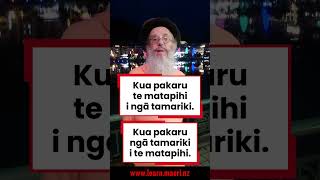
Kua pakaru i a Pāpā te motokā.
The car was broken by Dad.
Statives with 'i' - i a, i te, i ngā
Kua pakaru te motokā i a Pāpā.
The car was broken by Dad.
Statives with 'i' - i a, i te, i ngā
Mā wai te papa e muku?
Who will mop the floor?
Who will? - mā wai?
Ko wai kāore i tākaro i te papa tākaro?
Who didn’t play at the playground?
Who didn't? - Ko wai kāore...
Kāore ngā tamariki e āhei te tākaro i te papa tākaro.
The children are not allowed to play at the playground.
Not allowed - kāore... e āhei
Ka whakatūpou ia, ko tōna upoko ki raro, ko ana waewae ki runga ki te pana i tōna pāpā i a Rangi.
He bent down and placed his head on the ground, and threw his legs up to the sky onto the body of his father, Rangi, so he could push.
Ka Taika te pāpā.
Taika is the father.
Ki tā te Awara, ko Hei te pāpā o Waitaha.
According to Te Arawa, Hei was the father of Waitaha.
Kua mā te papa?
Is the floor clean?
Āe, kua mā te papa.
Yes, the floor is clean.
Titiro ki te papa tuhituhi.
Look at the board.
I pāngia taku pāpā ki te mate korona.
My father has covid.
Kāhore e Mā, māku te papa e tahitahi.
No worries Mum, I will clean the floor.
Kei hea tō pāpā?
Where is your father?
Rite tonu koe ki tō Pāpā ki te whaikōrero.
You're just like your dad at making speeches.
He tangata atamai tō pāpā.
Your dad is an intelligent person.
Rite tonu koe ki tō Pāpā te hūmarie.
You are just as kind as your dad.
I pakeke tō pāpā i hea?
Where did your dad grow up?
He uri nō Ngāti Maniapoto, Rereahu, Te Rarawa ki tōku pāpā taha; ko tōku māmā taha nō Tūhoe, nō Te Whānau-ā-Apanui hoki.
I am a descendant of Ngāti Maniapoto, Rereahu, and Te Rarawa on my father’s side; and on my mother’s side, I am from Tūhoe and also Te Whānau-ā-Apanui.
Tōku pāpā.
My dad.
Ko Pāora tōku pāpā.
My father is Pāora.
Ko Piripi tōku pāpā.
Piripi is my dad.
Kua pāngia taku pāpā ki te mate korona.
My father has gotten sick with Covid.
Ngā mihi nui mō te Rā o te Pāpā.
Happy Father's day.
I tahitahi ngā tamariki i te papa.
The children swept the floor.
Ko Nikau te pāpā.
Nikau is the father.
Pāpā Pea
Father Bear
I tīmata te ao i te moenga o Papa i a Tangaroa.
The world began with the union of Papa, the earth mother, with the sea, Tangaroa.
Ko Tame te pāpā o Aroha.
Tame is the father of Aroha.
Āta kawea te pereti kei taka te kai ki te papa.
Slowly/carefully carry the plate or the kai might fall on the ground.
Ka whāngai a Pāpā i tēnei ngeru aituā.
Dad will feed this unlucky cat.
I haere au i te taha o tōku pāpā ki tōna wāhi mahi.
I went with my father to his work.
Kei te puruma te tama i te papa.
The boy's sweeping the floor.
Āta tapahia ō mīti, kei purere ngā kai ki te papa.
Cut your meat carefully, or the food might all fly off onto the floor.
Ā, ka hīkoi mātou i te taha moana ki Te Papa.
And we walked by the sea to Te Papa Tongarewa National Museum.
Ko Tāmaiti te pāpā o Matiu.
Tāmati is the father of Matiu.
Kua mā te papa.
The floor has been cleaned.
Tōku pāpā.
My father.
No Ahuriri tōku pāpā.
My father is from Napier.
Kei te papa tākaro.
At the playground.
Pāpā, nāku kē i raka te whare, nā Rangi i whakaweto te hikohiko. Kua pai tātou.
Pāpā, I locked the house. Rangi turned the power off. We are fine.
Kei Poneke, kei Te Papa.
In Wellington at Te Papa.
Tokotoru ngā tama kei te papa tākaro.
There are three boys at the playground.
Tokotoru ngā tama kei te papa tākaro.
There are three boys at the playground.
Kua rite māua, Pāpā. Ka haere ināianei?
We're ready, Dad. Are we going now?
Kei hea te pāpā?
Where is the father?
Kei te haere rāua ki te papa tākaro.
Those two are going to the playground.
He papa kōhatu a Pānia ināianei.
Pānia is a flat rock now.
Ko Pānia he papa kōhati ināianei.
As for Pānia, she's a flat rock now.
Kei te pīrangi au ki te hoko i tēnei mō taku pāpā.
I want to buy this for my dad.
Ko Hone tōku pāpā, ko Rāhera tōku māmā.
Hone is my father, Rāhera is my mother.
Kei te haere a Raureka rāua ko Te Naera ki te papa tākaro.
Raureka and Te Naera are going to the playground.
Kei te haere rāua ki ngā papa tākaro.
Those two are going to the playgrounds.
I te kōrero mai a Pāpā ānō nei he kūare māua.
Dad was talking to us as if /like we (2) are stupid.